Historic Preservation
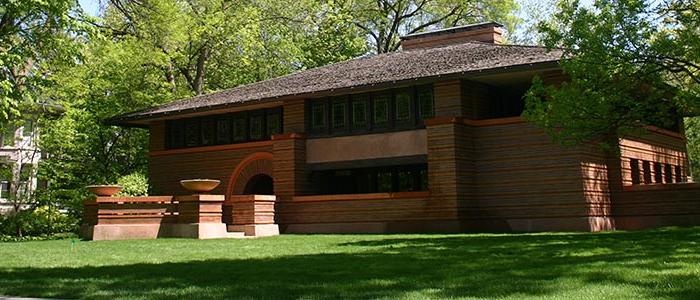
The Village of Oak Park is internationally recognized for its rich history and longstanding commitment to historic preservation. The community is especially renowned as the former home of architect Frank Lloyd Wright, who lived and worked in Oak Park from 1889 to 1909. His legacy, along with the Village’s dedication to preserving its historic character, has helped establish Oak Park as an internationally recognized destination for history, architecture and cultural heritage.
The Village is home to three historic districts: the Ridgeland/Oak Park Historic District, the Frank Lloyd Wright-Prairie School of Architecture Historic District and the Gunderson Historic District. Together, these districts encompass approximately one-third of the Village and are locally designated and listed on the National Register of Historic Places.
Oak Park’s commitment to historic preservation extends beyond its architectural resources to include the protection and recognition of the community’s broader historical, cultural and civic heritage. This commitment is reflected in 11 buildings and one park listed on the National Register of Historic Places, one building recognized on the UNESCO World Heritage List and more than 70 locally designated historic landmarks. Through preservation, education and community stewardship, Oak Park continues to safeguard the places and stories that contribute to its distinctive identity.
The Historic Preservation Process
The Historic Preservation Commission, an 11-member body of citizen volunteers, was created in 1972 to preserve and promote the significant historic and architectural heritage of the Village. The Commission reviews building permit applications for exterior alterations, additions, new construction and full or partial demolition of properties located within historic districts or designated as historic landmarks. The Commission also identifies new landmarks and historic districts, and seeks to enhance the attractiveness of the Village by educating property owners and citizens about the importance of preservation, restoration and rehabilitation.
In a historic district, most buildings contribute to the significance of the area without having the credentials individually of a landmark. These buildings are referred to as contributing resources. They help maintain the historic integrity of the neighborhood. Buildings that do not contribute to the significance of the historic district are usually less than 50 years old or have been altered significantly in the recent past. These buildings are referred to as non-contributing resources.
A Certificate of Advisory Review is for properties located within one of the Village's historic districts or for any property owner seeking advice regarding a building permit. A Certificate of Appropriateness review is for historic landmarks, projects that propose full or partial demolition in a historic district or properties being altered with Village funding. The Historic Preservation Commission does not review ordinary maintenance and repairs that do not require a building permit, such as exterior painting. The Commission bases it reviews on the Village of Oak Park's Architectural Review Guidelines. These guidelines follow the review criteria set forth in the U.S. Secretary of the Interior's Standards for Rehabilitation. In addition, owners of historic buildings may be eligible for tax incentives.
Click here for the online application for an Advisory Review
Click here for the online application for a Certificate of Appropriateness
Click here for the paper application for a Certificate of Appropriateness(PDF, 289KB)
Researching Your Oak Park Home
Finding the history of your house and the land on which it sits can be both entertaining and rewarding. It can help you understand your building's part in Oak Park's history and may inform future preservation or restoration efforts.
Trace the History of your House
Historic Resource Database
The Village of Oak Park maintains a historic resources database that includes information such as construction date, architect, builder, architectural style and description and significant owners for properties in Oak Park historic districts.
Historic Resource Database
Preservation Awards
Each year the Village, through its Historic Preservation Commission, recognizes outstanding preservation efforts with a special award. Single-family residences, apartment buildings, commercial buildings, public/institutional buildings and religious structures can be nominated in the categories of restoration, rehabilitation, adaptive use and additions/new construction. Additional awards are presented for stewardship, detail and design. Nominations need not be in an historic district. Interior work also may be considered in conjunction with exterior work. Any resident, owner or tenant of eligible structures, members of local preservation and historical societies, and members of the Historic Preservation Commission may make nominations. Nominations may be made online or via email.
The judges' decisions will be based upon the Historic Preservation Commission's Architectural Review Guidelines, which are based on the Secretary of the Interior's Standards for Rehabilitation, as well as considerations of contextual and design appropriateness.
Land Acknowledgement
The Village of Oak Park is positioned on the ancestral homelands of the Potawatomi people, who cared for this land until they were forced out by non-Native settlers. The Ojibwe, Odawa, Peoria, Kaskaskia, Miami, Mascouten, Sac and Fox, Kickapoo, Ho-Chunk, Menominee, and tribes whose names have been lost as a result of genocide also lived, gathered and traded in this region. The Historic Preservation Commission acknowledges the incredible contributions of Indigenous communities and commits to an ongoing collaboration to share a complex and inclusive history. To learn more about the native peoples who call northern Illinois home please click here.